
Throughout the early 20th century the traditional Pin Up was big business in the world of commerce and entertainment. In the advertisements found in newspapers and on the covers of magazines the Pin Up was exquisitely drawn and painted by talented artists and then mass reproduced in the effort to sell the 'American Dream' to the public.
The illustrated Pin Up was everywhere yet her image was seldom seen with darker skin.
I really love the traditional Pin Up art work of the 40's through to the 60's, it is so well executed and has always inspired me, but I found it disappointing that I could find hardly any non white models painted by my favourite artists!
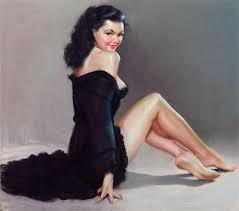
A model of indeterminate race by Gil Elvgren, confusingly tagged as a 'black' Pin Up by some sources
As we saw in my last few posts, the black Pin Up was definitely around, she existed in models and dancers, performers and actresses, so why was she not seen selling shiny products and lifestyles to the masses?
In this case I can only presume that when it comes to advertising, companies went with the image that would sell the most products. Even though a select few burlesque shows and girly magazines did cater to an African-American audience, in the larger scheme of things that audience was in the minority, and if everyone still needed to buy universal items like household cleaners and petrol, then the white Pin Up was the girl to put on the ad.
Saying that though, I did locate a few examples of non white Pin Up illustrations, but even these were difficult to find and had little or no information to give them any context.

There's this dark skinned beauty from a 1955 calendar. It's frustrating that I don't know who the artist was or the reason this calendar was made. This image has a back story we might never know. I like it though. The model is vivacious and sexy and her skin colour seems to me to have no influence on how she has been portrayed. This makes me think the calendar was aimed at an African-American audience because, as we have seen in past posts, the white mainstream audience of the era found it difficult to accept a black female as sexual/sensual without racially stereotyping her first and taking away her identity.

On a different note, this earlier lady from the 1940's who is finding it hard to keep her clothes on is ticking all kinds of dark skinned cliches. This makes her obviously 'A' exotic and 'B' slightly primitive. Surrounded by greenery she could be a jungle dweller or an island savage, either way she is provocative and passive. Despite these visual tropes I find this picture beautifully painted and a real treat to look at.
I was losing all heart at finding any other relevant art work, when, out of the blue, I stumbled across a range of images by the quintessential Pin Up artist of the vintage era, Alberto Vargas. Best known for creating airbrushed images of the all-American girl next door for over 30 decades, Vargas produced a series of Afro Pin Up's for Playboy in the 1970's.


Taking a cue from the trend for Blaxploitation films that were enjoying huge success during the early 70's, you can see how the idea of a black Pin Up must have been both titillating and unusual for a mainstream audience. Similarly, like the Blaxploitation genre, these images can be seen to either empower their black subjects or perpetuate racial stereotypes.
I for one wasn't sure how to approach these images. Taken in context of their time, they show sexual beings who seem to have a claim over their identities, yet those identities are marginalised at best. When I look at them as artefacts from a rich history of black female representation, then they seem to take on a different sort of meaning. They show a development in how the black female was being represented. They acknowledge that white men were taking an active interest in the black Pin Up, not for token value or as a two dimensional cartoon but as actual women. Seen it that sense, they are a pretty big deal.
This notion of black females having allure went some way to narrowing the racial divide, even if it does throw up arguments about mainstream female representation in general.
-
Next time I'll be exploring further into the history of the black Pin Up and ideas of racial fetishisation and objectification, join me then, for more investigation into the hidden Pin Up.


