Showing posts with label 1940's. Show all posts

Saturday, 3 April 2021

Lockdown Leading Ladies: Mirrors

Something I've noticed while watching the films of the Forties is that mirrors are often used as devices to show the leading ladies inner thoughts, turmoil and unease. In films such as Gaslight we see the character of the wife driven to near madness by her manipulative husband reflected in her music box, her slip into despair shown upside down and distorted. In Possessed, Joan Crawford's portrayal of the hallucinating Louise is shown as several images in the same shot, reflected in her dressing table mirror, and Rita Hayworth is shown in a multitude of false and real mirrored images in a hall of mirrors revealing her duplicitous nature in The Lady from Shanghai.

I began to play with mirrors and reflections in my own work as I figure out my feelings of lockdown/ Covid anxiety and unease using classic movies as inspiration. The first thing I realised was that shooting with mirrors is really difficult when you don't have much room or designated space. Trying to get the reflection I wanted in the mirror and the camera isn't easy. A lot of the time I got unwanted furniture, fridges, cat food bowls, and even the camera itself either shown in the mirror or behind it, so setting up took some time. Here's an early try out where having sections of the room in the mirror really limited what I could shoot, especially as I was holding the mirror at the same time. I do like how there is an unspoken story in this image though.

Eventually I hung the mirror on a plain wall where the reflection was plain too and this made taking the images much easier, though as it was on a landing, I didn't have much space to move. I played with having myself and the reflection in shot and just my refection which in this set up worked much better.

This really created an otherworldly feeling of being trapped or separate from the real world. Not knowing what to do in the mirror, a lot of the time I just stood still and looked straight ahead. Or as in this case turned my back on it completely, adding another layer of separation from the viewer. There's a mysterious element to not seeing a person's face that leaves you feeling unresolved. I also like how my 1940's set hair looks quite sculptural and is what really 'makes' this image.


Lighting was also tricky because, using the limited sources I have at home, I was trying to light myself but then looking into the mirror the reflected me could look lit in a totally different way. That's when I started to experiment with a smaller handheld mirror. This way I could move about to get the best light, but it also gave the images a new feeling. I tried a few videos using both mirrors trying out simple movements and looking into the mirror and at the viewer through the mirror.


On a different day I played with the handheld mirror, moving it around my face while being filmed and photographed from the front. I was able to have set lighting this way and I really liked how the reflections and light changed as I moved the mirror. I moved very slowly and then slowed the video down even more to play with anticipation of seeing the face change in the mirror. I'm not sure if this worked but I enjoyed the aesthetic and creating this piece.


Behind the glamour there is always a lot of faffing and retaking shots. I like that in a way, these images in themselves are a manipulated version of reality existing in an alternative world, a reflection of my mind during the pandemic.

Monday, 22 March 2021

Lockdown Leading Ladies


It started back in January when I watched the 1950 movie Sunset Boulevard. It's a film I've enjoyed before, but this time something about watching the character of Norma Desmond descend into madness all the time looking magnificent, while I, like the rest of the world struggled through a pandemic, really struck a chord with me. Her stunning expressive face and glamourous deterioration was so awe inspiring that the next free afternoon I had I was grabbed by the impulse to channel Norma and take some photos of myself.

I enjoyed the experience and the resulting pictures so much that the next week I watched another classic movie with a strong female lead, the 1947 hit 'Possessed' starring Joan Crawford. This film has Joan slowly losing her grip on reality through her obsession with a playboy architect who doesn't reciprocate her feelings. The film culminates in a 'did she, didn't she' murder, as hallucinations mix with the real world.

I've always loved the films of old Hollywood for their glamour and melodrama, but watching them now, particularly in 2021 during lockdown 3.0 my attention has been grabbed by how the female stars portrayed women on the edge, losing their minds with impossible glamour and endurance. While watching old movies has always given me comfort, these suffering powerful ladies are also giving me strength to face the current challenges around me and my god, I love them for it! This was the first time since lockdown started last year that I felt compelled to create something entirely for the joy of it.

I've since been playing around with the visual styling and language of these old movies to try and convey some of the various feelings of paranoia, isolation, threat and fear that Covid has installed in many of us over the past year, leaving many like me, stuck in a world of uncertainty and stagnation. There's a satisfying fit between the aesthetics of Film Noir and melodrama and these times of Covid; A constant feeling of threat, danger and psychological angst.

I began by channeling the stars of the films I have watched, not trying to look exactly like them, but to gently reference them through make up and styling, and try to pick up some of the pitch of their performances in my poses and lighting. I also have really enjoyed using black and white photography to create that otherworldly feel of old films that are so evocative and alluring, whilst completely of their own time.

As I started to explore ideas I tended to allude to general styles of the old Hollywood era instead of the actual stars. I also began to play with projecting images onto myself to layer narrative. I have never used myself as material in my own work, except for the odd painted self portrait (see the banner to this blog for instance), so photographing myself was and still is strange to me. It feels very immediate and open to use my own image this way.


I also began to experiment with video, just short trials to see how things looked like here where I projected Corona Virus cells over my face, purposely staying still like a paused film as the pandemic washed over me. It made me also think about how stuck in a moment we all are during this world event.


I watched the British 1940 film Gaslight which sees a wife begin to believe shes losing her senses through the mental manipulation of her husband, It's a fantastic film and gives a strong sense of outside influence invading ones mind. On the back of this I made a short clip about Hands, Face, Space and the unease and paranoia that was being felt as we went about our daily lives, using some of the film's soundtrack to perform to (sound on).


I am not overthinking any of my process, just making sure I enjoy making it and seeing what comes out. It's important to me now more than ever that I don't stress over the outcome, which is ironic when I am using the stress and anxiety myself and many others have experienced over the past year due to Covid as part of my inspiration.

In short I am enjoying using so many of the things I already love, like dressing up, (I'm trying out original 1940's and 50's setting patterns to set my hair into authentic waves and curls, which is an added boon as we can't visit hairdressers at the moment), glamour and camp, history and story telling to make work that is literally getting me through.The preparation is as much fun as the actual making of the work, though setting up my phone to exactly the right angel to avoid getting unwanted items in the shot can be stressy, especially when photographing mirrors (more of that to come in future posts!).
 
I'm not a technical person, so I like the simplicity of just grabbing my phone to experiment, clicking and creating an idea and a mood. It's all work in progress, but yes, Mr DeMille, I'm ready for my close up...
 

Wednesday, 15 May 2019

Goodbye Doris


Have you ever seen Calamity Jane? Its the 1953 technicolor musical that follows the story of the wild west heroine with her sharp shootin', rootin' tootin' ways and her secret love for Wild Bill Hicock. 

BUT, basics aside, have you ever REALLY watched Calamity Jane, and by that I mean Doris Day's extraordinary performance? She bolts off the screen like a ray of golden light all energy and purpose. As Calam', Doris fully embodies every ounce of the loud, bragging, arm flailing heroine. She is a powerhouse of acting. It's amazing when you see her move, when you hear her sing!

Doris' honey smooth voice was both soothing and invigorating, it could be lilting and soft or ramped up to full force, but never anything but perfection. 

How bothersome then, that Doris' talents not just for musicals but comedies and dramas too have been overshadowed by her branding as the virginal all American goody two shoes, that has become a kitsch cliche at best and a false caricature at worst.

In reality she wasn't all apple pie. She was a women making her way in a male dominated industry. She was taken advantage of and betrayed by those closest to her (three marriages, one bankruptcy and an ageist Hollywood system) and pigeonholed into money making projects that kept her in a safe two dimensional bracket, that she somehow manged to rise above and shine.


My appreciation for Doris didn't truly begin until my 20's. Before that I'd always assumed she was too blandly wholesome. My god, how wrong I was! Watching Calamity Jane for the second time as an adult I realised I too had massively underrated her. I was grabbed by her vitality and her ability to go full force into a character while never veering into absurdity. She owned every scene she was in, her very physicality projecting her beyond the surface of the screen.

Spending time with her well known later films, those screwball 60's romance comedies she's so well known for, its wonderful to see how she embraces the campness and runs with it. These films cemented the whiter than white stereotype associated with Doris but she made what could have been flimsy character roles into memorable iconic performances that defined an era of golden Hollywood and popular culture to come.


Doris' will always be linked with Wake Me Up before You Go Go

Iconic work by artist Alejandro Mogollo (used with kind permission by the artist) 

Doris Day has been there my entire life, a legend hidden somewhere in California. It was enough to know she still existed; one of the Hollywood greats. I fully respected her decision to retire in the 1980's and focus on her charity work for the Doris Day Animal Foundation, yet when she released her album My Heart, at the age 89 it was exciting to hear her lovely voice once more and know she was still working her magic.

To know that Doris has gone is a great loss. I hope that people look back at her catalogue of work and feel as wowed as I have. I hope she is always remembered for the right reasons, for her undeniable talent and skill as a performer and the charity work that will continue in her name. I hope that right now Doris is having the best time, her glorious mega watt smile lighting up the heavens, because, after all, who can make 'the sun shine brighter than Doris Day'?

Wednesday, 3 May 2017

The Hidden Pin Up #4 - The Black Pin Up Illustrated

Throughout the early 20th century the traditional Pin Up was big business in the world of commerce and entertainment. In the advertisements found in newspapers and on the covers of magazines the Pin Up was exquisitely drawn and painted by talented artists and then mass reproduced in the effort to sell the 'American Dream' to the public.

The illustrated Pin Up was everywhere yet her image was seldom seen with darker skin.

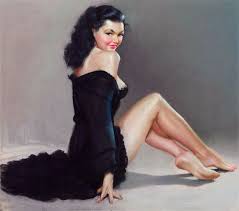
I really love the traditional Pin Up art work of the 40's through to the 60's, it is so well executed and has always inspired me, but I found it disappointing that I could find hardly any non white models painted by my favourite artists!


A model of indeterminate race by Gil Elvgren, confusingly tagged as a 'black' Pin Up by some sources

As we saw in my last few posts, the black Pin Up was definitely around, she existed in models and dancers, performers and actresses, so why was she not seen selling shiny products and lifestyles to the masses?

In this case I can only presume that when it comes to advertising, companies went with the image that would sell the most products. Even though a select few burlesque shows and girly magazines did cater to an African-American audience, in the larger scheme of things that audience was in the minority, and if everyone still needed to buy universal items like household cleaners and petrol, then the white Pin Up was the girl to put on the ad.

Saying that though, I did locate a few examples of non white Pin Up illustrations, but even these were difficult to find and had little or no information to give them any context.


There's this dark skinned beauty from a 1955 calendar. It's frustrating that I don't know who the artist was or the reason this calendar was made. This image has a back story we might never know. I like it though. The model is vivacious and sexy and her skin colour seems to me to have no influence on how she has been portrayed. This makes me think the calendar was aimed at an African-American audience because, as we have seen in past posts, the white mainstream audience of the era found it difficult to accept a black female as sexual/sensual without racially stereotyping her first and taking away her identity.


On a different note, this earlier lady from the 1940's who is finding it hard to keep her clothes on is ticking all kinds of dark skinned cliches. This makes her obviously 'A' exotic and 'B' slightly primitive. Surrounded by greenery she could be a jungle dweller or an island savage, either way she is provocative and passive. Despite these visual tropes I find this picture beautifully painted and a real treat to look at.

 I was losing all heart at finding any other relevant art work, when, out of the blue, I stumbled across a range of images by the quintessential Pin Up artist of the vintage era, Alberto Vargas. Best known for creating airbrushed images of the all-American girl next door for over 30 decades, Vargas produced a series of Afro Pin Up's for Playboy in the 1970's.


Taking a cue from the trend for Blaxploitation films that were enjoying huge success during the early 70's, you can see how the idea of a black Pin Up must have been both titillating and unusual for a mainstream audience. Similarly, like the Blaxploitation genre, these images can be seen to either empower their black subjects or perpetuate racial stereotypes.

I for one wasn't sure how to approach these images. Taken in context of their time, they show sexual beings who seem to have a claim over their identities, yet those identities are marginalised at best. When I look at them as artefacts from a rich history of black female representation, then they seem to take on a different sort of meaning. They show a development in how the black female was being represented. They acknowledge that white men were taking an active interest in the black Pin Up, not for token value or as a two dimensional cartoon but as actual women. Seen it that sense, they are a pretty big deal.

This notion of black females having allure went some way to narrowing the racial divide, even if it does throw up arguments about mainstream female representation in general. 
-

Next time I'll be exploring further into the history of the black Pin Up and ideas of racial fetishisation and objectification, join me then, for more investigation into the hidden Pin Up.

Thursday, 23 March 2017

The Hidden Pin Up #2 - Black Vintage Burlesque

In my second post exploring the history of the black Pin Up I want to look at the world of burlesque during it's hey day during the 1950's and early 60's. With Neo burlesque well and truly now a part of mainstream culture (nipple tassels from Ann Summer's anyone?) it would be easy to assume that today's burlesque superstars are direct examples of the original scene, but that wouldn't be strictly true. For every Dita Von Teese and Immodesty Blaize today, there was a black performer equally as talented and devoted to the art back then. It could be that the media (then as now) chose to ignore performers of colour in favour of the white all American version.

So with this in mind here are some black burlesque performers who should be as well known as the legendary Tempest Storm and Dixie Evans but have fallen from view. Let's take a look at their incredible careers...

Jean Idelle

Imagine, it's 1950 and you're a young black woman who has just told your mother you want to become a burlesque dancer. She, in trying to guide her daughter to opt for a less salacious career, sends you to speak with the local pastor. Thankfully, the pastor is a man with a liberal outlook on life and tells you, if it's what you really want to do, to follow your dreams.

With Gods blessing Jean Idelle went on to become one of the most sought after exotic dancers of her era. She was a naturally gifted dancer and having studied under Katherine Dunham, she was soon 'discovered' and began performing at Minsky's Burlesque show in Chicago where she worked her way up to become a headline act taking to the stage between 1950 and 1964.


Idelle's trademark performance was dancing with huge white ostrich feather fans and at the height of her career she was earning around $1000 a month. By today's standards that's around $8600, which for a black performer makes the sum even more impressive considering the racism and segregation of the time .


The amount of money Idelle was making was due to her impeccable performances. Professionalism was very important to her and she was never late never sick or sloppy. For such a woman to be so successful both professionally and financially it seems odd that her name is not better known.

Perhaps Idelle's true legacy should lie in her success at performing in both white and black clubs across the U.S and Canada. It can't have been easy staying true to your art in the face of adversity.

Lottie 'The Body' Graves

By the 1960's burlesque was beginning to loose it's appeal. In order to gain bigger audiences the focus became less about the art form and more about the strip, resorting to showing more skin, and mingling with the punters.


Having been classically trained as a dancer, Graves began her burlesque career at the early age of 17 and brought a dash more class to her performance. She stood out thanks to her elegant moves and outstanding figure.


Graves said that exotic dancing was 'top of the shelf, the champagne of dance' and her polished art form gave her the opportunity to lead an equally glamorous lifestyle rubbing shoulders with the likes of Billie Holiday, Louis Armstrong and Aretha Franklin.

Motown legend Martha Reeves a friend and neighbour stated,

'She held her own. Lottie had skills that were superior to all of her competitors. She out-danced them all.

She had body movements that only she could pull off, and very elaborate costumes. And I know she can still dance, and does a high kick that shows a lot of young ladies [up]'


Like Jean Idelle, Graves can be credited with breaking through racial tensions at the height of open racism by performing at white clubs. Never classed as a stripper, Graves unique moves set her apart from other bump n grinders and she transcended both the burlesque and racial barriers. 

Toni Elling

At the age of 32 Toni Elling began stripping quite late in life. It was 1960, and after spending nine years struggling to get a promotion in her telephonist job, and being denied one because of her race, Elling had had enough. It was after taking some advice from her friend Rita Revere, herself a stripper, Elling decided to give the burlesque scene a try.


Taking her stage name from Duke Ellington, Elling started her new career in The Flame Show Bar in Detroit. (She and Ellington were good friends and it is rumoured he wrote the song 'Satin Doll' in her favour). 

Of her first gig Elling said, “I was surprised I knew what to do and that it went over so well. I wouldn’t get an agent, though. Didn’t know why I needed one. So many places I couldn’t work because of the colour thing. An agent who was a friend booked me in Lima, Ohio. Word got around and after that, I found it easy to get work outside Detroit. I finally got a bit of a reputation.”


She had many gimmicks to fill out her repertoire. A Spanish act in a flamenco dress, a wedding dress strip and even a street walker character. But Elling got frustrated by other performers stealing her routines. Because of this she decided to do something few others could mimic, an Afro act. "There weren’t that many black entertainers in Oregon at the time. Nobody could copy that". She also included singing into her routines which went down well with her audiences.


Elling's cool and elegant demeanour earned her much praise in the burlesque community and opened doors, taking her to places other black performers had been denied. She toured the U.S Canada and even took her act as far as Japan.

-

There were many amazing performers to choose from while researching this post, it's worth mentioning a couple more who caught my eye; the statuesque Ethelyn Butler who used exotic dancing as a bridge to ballet...


 ..and the exquisite Sahji Jackon who appeared in a movie alongside Dizzy Gillespie. Both of these ladies must have fantastic back stories, yet I could find little about them!


It was good to learn how diverse burlesque was (and still is), but eye opening to see how little non white performers get to be in the lime light. I'm really glad that on the whole these women took control of their careers and images and made names for themselves. I think they deserve as much applause as possible.

Next time I'll delve into the girly magazines of the vintage era to see how the black Pin Up was represented in the age of Bettie Page and her colleagues.

Thursday, 16 December 2010

Mrs Brown's wardrobe


So sweet, maybe too good to be true, a frilly cotton set of underwear found in the decorative arts collection in Stoke

After much drooling I managed to pull myself together enough to share the photos from Tuesday's visit to Stoke Potteries Museum and Art Gallery! These pictures don't really do the garments I saw justice. To see a picture is one thing, but to see the clothes up close is another thing entirely. They are almost like time capsules, in that they embody times gone by and individual pasts.

Some had hand stitching and repairs and some still had the original price tages still attached. But all were of interest:

The first thing we looked at were dresses from the correct era, late Forties, early Fifties. I was looking out for the distinctive influence of Dior's 'New Look'; The nipped in waist and full skirt. But many of the dresses, though beautiful, were still boxy and focused on the shoulders.


This blue number had a high neck and lovely detailing on the shoulders


Quite unassuming at first glance I think this red dress would have been stunning when worn. It has a high neck and would give the wearer an elegant column shape. Very film star!


I felt very drawn to this hot peach dress for the character of Mrs Brown. Although is isn't as up to date as I'd have liked, the colour is quite unusual and the material is light and floaty, fun and young. The skirt is slightly fuller than the other dresses, maybe this dress is on the verge of the 'New Look' revolution?

Some of the other dresses were very much evening attire and were very stylish. When looking for the brand label I was impressed to see many of them had been hand stitched and were obvioulsy hand made, maybe from patterns found in magazines like those found in Vogue. It highlighted how common it was to sew your own back in those days as off the peg clothes were still relatively new and seamtresses were for the well off. But that didn't stop some women creating some exquisite designs!


This long evening gown has a full skirt and a focus on the bust area. It came with a little cropped jacket. When we looked inside, there was obvious stitching holding the strips of sequins in place. The kind of stitching done at home, certainly not a seamtress or machine.


Another beautiful example of hand stitching. This dress had no makers label. Here you can see a definate direction towards the 50's with a halter neck, emphasis on waist and full skirt!


This dress really stood out for me. Not only is it stunning, it strides both decades perfectly. You can see the Paris influence and it has a bold and young pattern. I love the pink satin fins which draw attention to the waist. It's very stylish. I was worried it might be too posh for Mrs Brown, maybe beyond her means but I have been told that the dress was purchased at a sale at Marshall and Snelgrove, a department store that by the 1950's was losing business and eventually merged with the company which eventually became Debhanams.


Another example of fabulous evening attire! This dress was from the Heiress brand. Although this sounds quite upper class I'm told by the museum it was similar to the Horrocks label in that it sold affordable off the peg fashion. A strong contender for Mrs Brown's outfit.


We also looked at 1950's cocktail dresses. These, though gorgeous, were too advanced for the era of the project, but they were worth taking photos of just so you can see!


The skirt of this dress was so stiff it stood out on it's own with a built in crinoline!


This dress evoked much sighing when it was discovered. It is simply a dream frock, layers and layers of floatly white in a girly prom style. The bodice is boned and the skirt is very full and soft. It is screaming to be put on and adored!

Next came underwear. I was looking for suspenders, bras, and slips. The slips let me tell you were a real suprise treat!
Wartime and rationing; you'd expect very simple unembellished articles. Not pink, frivolous numbers and silky peach Utility!


This peach slip bears the Utility label. Most of the Utility slips we found were of the same style, simple yet suprisingly pretty


The shop ticket was still attached to this slip which was in perfect condition!


A very girly touchable slip, with a full petticoat, perfect for those full Dior style skirts


This was certainly the find of the day! A pink gorgeous slip made by a brand called Movie Star. The Museum's archives tells it was brought over from America during the war! A present from a soldier? A black market accquision? Or an overseas gift from a family member?


An advert for the USA brand Movie Star. The company later changed it's name to Stardust, and the founders even went on to create a modelling accademy and talent agency! With such emphasis on glamour and elegance inspired by the famous women of the silver screen I can see Mrs Brown being enchanted with this idea and being very happy to own a bonafide American item of clothing so closely associated with the movies she so loves!

Some of the underwear wasn't quite so evocative. Upon our searches we found a huge rubber girdle, complete with lacing and a strong unpleasant smell of old rubber. But this was joined by more refined undies; boned all in ones and bullet bras. Not to mention a lovely frilly set of knickers, like something from a 50's dream:


The Beast, as it became known that day! This was a seriously big rubber girdle!


In complete contrast, small boned slip which would have given a refined shape


A mesh girdle with bra in one


Big knickers, not just somehting from Bridget Jones then.


It's difficult to see here but this bra was a classic vintage pointy shape


I enjoyed these wooly all in ones. It's easy to forget that during the austere times of war and after a pair of warm undies like these would have been very welcome. In fact they were common across all classes with adverts for ladies wool underwear being found in Vogue magazines of the period.


My head is full of ideas from this wonderfull collection of clothes! I now have to decide what would best suit Mrs Brown, and work in her dressing room set. Some more research I think and I'll be there, I already have some favourites, but it's not about what I'd like, it's what would fit the story of Mrs Brown the best given her character and circumstances. I'll let you know how it goes.

P.S once I've decied on the outfit and underwear, we can start to build on her accessories; hats, gloves, jewellery and shoes!