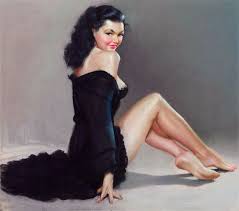
Today I learned that Hugh Hefner the founder of Playboy Magazine and head of the Playboy empire, has died aged 91.
Hefner has always been a controversial figure in women's history; he claimed to empower women by printing the first publication to accept that women had their own sexuality and sexual desires. This was at a time when women were very much boxed in and expected to follow the wife and mother role, staying demure and wholesome. His ethos worked alongside the growing women's movement by broadening women's outlooks and helped to kick-start the change in society's ideas about the choices a woman could make.

However it can't be overlooked that Hefner has been partly blamed for the ever growing sexualisation of women by viewing them only as sexual objects for the entertainment and pleasure of men. By promoting women's worth through their looks and sexual promise it is argued he has marginalised women's importance in society by perpetuating the idea of youth and beauty as their most important commodity.
Either way Hefner has left an undeniable mark on popular culture worldwide. He has always fascinated me and I have flipped from admiration to repulsion to somewhere in between the more I have learned about him.
Say whatever you like about Hefner and his legacy, he was liberal enough to embrace all races in his magazine, opening up the pages to many black activists and entertainers long before other mainstream platforms followed suit. Martin Luther King, Ella Fitzgerald, Muhammed Ali, Sammy Davis Jr and Malcom X all frequented the publication at a time of civil unrest and racial divide.
Say whatever you like about Hefner and his legacy, he was liberal enough to embrace all races in his magazine, opening up the pages to many black activists and entertainers long before other mainstream platforms followed suit. Martin Luther King, Ella Fitzgerald, Muhammed Ali, Sammy Davis Jr and Malcom X all frequented the publication at a time of civil unrest and racial divide.

In March 1965 Playboy published the first black model as it's centerfold. Jennifer Jackson was chosen as the first black Playmate of the month, a revolutionary move for a mainstream platform that catered for a white American male audience. As I have previously mentioned in other posts, when a black woman was celebrated in this manner for her beauty and not fetished for her race, it was a huge step towards narrowing the racial divide, regardless of the female objectification the era provided.
Interestingly, Jackson has since stated that she never thought that she was pretty, saying, 'there were so many other girls who were so much prettier than me. it's just white mans beauty is different to black mans beauty - I was tall and leggy, white men like that. Black men on the other hand like the girls who were short and had what they called "a brick house body". I didn't get any attention from the brothers. They liked the women who were short and shapely. So there was a different standard of beauty'.
Jackson was the first of a series of black Pin Ups to grace the magazine and work the Playboy clubs. She was followed by Jean Bell in 1969 as the second black Playmate of the month who also became the first black Playmate on the cover (all be it accompanied by four other models).

Then 1971 saw an iconic cover featuring African American model Darine Stern posing on the famous bunny head chair. She was the first black woman to take centre stage on the front of Playboy. With her huge Afro, and not much else she made a powerful statement about black culture moving into the mainstream after the height of the American Civil rights movement.
This was a time where black culture was embracing its heritage and taking back control of the stereotypes white culture had used against it for centuries. Hence the Afro and a curvaceous figure were identified with power and pride by the black community.

Moving on 40 years or so, it's not that unusual to see a black bunny or Playmate these days, though still quite rare. Last year did see Eugenia Washington from America's next Top Model become Playboy's Playmate of the year but she was only the 3rd black woman to be named since the magazine's launch over 60 years ago!

With Hef now shuffling off this mortal coil, I do wonder what direction Playboy will take. He was always the compass for the magazine, steering it towards topical subjects, advocating freedom of speech and championing civil rights as well as pushing the seedier sexual element and churning out playmate after playmate. It will be interesting to watch how things progress now that his tight hold is gone. In a time of increasing intolerance to race and gender equality (watch the news, read a newspaper, it's there), I can't help thinking that losing Hefner at this point could go either way in terms of progress (as backwards as that sounds when speaking of a man who made his fortune from the flesh of women).
If Playboy loses it's edge (as hidden by tits and big hair as it might have been), it would be a sad outcome for a magazine that since its birth, has consistently caused controversy by giving the world a broader idea of what the mainstream could look like. Lets hope whoever steps into his velvet slippers and smoking jacket has the vision and, please, the courage to keep pushing the boundaries of conservatism, but give women a real voice too.
If Playboy loses it's edge (as hidden by tits and big hair as it might have been), it would be a sad outcome for a magazine that since its birth, has consistently caused controversy by giving the world a broader idea of what the mainstream could look like. Lets hope whoever steps into his velvet slippers and smoking jacket has the vision and, please, the courage to keep pushing the boundaries of conservatism, but give women a real voice too.